蔚和平神父紀念彌撒 陳樞機講道

我們紀念蔚和平神父

他離奇地去世已兩年了,真相還未白,我們懷念他,婉惜他不再在我們中間。

我們當然也為他永遠的安息祈禱,為沒有被封聖的亡者教會要我們這樣做。

我以為我們更當讚美天主在我們這位兄弟身上做的大事,把他及大陸教友兄弟姊妹為信仰作出的犧牲再次奉獻,當然也為那些仍在水深火熱中的兄弟姊妹祈禱。

不過這時刻,我在天主面前覺得應該和在場的兄弟姊妹分析一下目前中國教會面對的問題,為能更準確的知道我們該求的是什麼。

保祿的書信說我們要為了信仰而受苦,我們和信仰的敵人要決鬥。

瑪竇福音說我們不能否認信仰的道理,為了忠於信仰要不怕殺身成仁。

可是,從教廷傳來的指示似乎是妥協,是投降,我們不能不感到困擾。

這幾年來我大膽地,也痛心地,向大家說教廷不一定等於教宗。在教宗本篤那幾年我在梵蒂岡看到的就是這樣的一個令人震驚的事實,教廷的高官膽敢不跟隨教宗。在把教宗的信譯成中文的時候他們竟做了手腳。教宗設立了一個關懷中國教會的委員會,他們竟藐視委員會壓倒性多數表決的意見。

我大膽出來說教廷不一定等於教宗,是為避免教友們以為教廷的一切指示都來自教宗。那幾年來教廷沒有跟隨教宗,他們陽奉陰違,以為自己比教宗本篤更了解怎麼處理中國教會的事務。

教宗本篤在退休前叫停了這一切,也作了人事調動。

教宗方濟各來了,他來自南美洲,他認識被難為的共產黨,不認識強權的共產黨。可惜的是他揀選的新國務卿很有問題。這位樞機就是以前國務院的副秘書長,他是多年去北京談判的教廷代表。教宗本篤調他去了委內瑞拉當大使。教宗方濟各叫他回來當國務卿。對他的任命很多人很讚同,他很斯文,更可以說是「甜言蜜語」,很得人心,我也天真地信了他,直至有一天在羅馬觀察報上看過他的一篇文章,竟描寫共產政權下中歐一些信仰英雄(如波蘭的維辛斯基樞機,匈牙利的閔真蒂樞機,捷克斯拉夫的若瑟.貝蘭樞機)為滋事者,逢政府必反對,喜歡在政治舞台出風頭,猶如羅馬鬥獸場的鬦士!?

他應該很了解共產黨,卻沒有補充教宗的不足,反而鼓勵他在樂觀的路上飛跑。

對話是重要的,必需的,但對共產黨政權過份樂觀,視外交重於信仰,為一定達成協議不設底線,為討好對方無止境地妥協,甚至負賣自己……這絕不是天主對教會的期待,絕不是忠於耶穌交給宗徒們的使命。

他們誤導教宗,令他做了不少糊塗的事,甚至給人恥笑,我們能不痛心?最近王作安說:「我們欣賞教宗想來中國的善願,不過條件還是那兩個:放棄和台灣的邦交,答應不干涉國內事務,包括宗教事務。」這不等於侮辱我們的教宗要他跪著去北京?

教廷怕得罪北京而喪失談話的機會,很多該做的事都不敢做了。

為蔚神父離奇的「被自殺」教廷曾向中央要求一個解釋嗎?當然沒有,甚至對「被失蹤」了廿年的蘇主教的下落中共也拒絕作任何交代!

政府在浙江拆了這麼多十字架,有些地方連聖堂也拆了,教廷有出聲嗎?

非法、絕罰的「主教」濫用神權,甚至祝聖司鐸,教廷出來譴責了他們嗎?

兩邊談判得越來越密,教廷不斷示善意,北京有回報嗎?一位絕罰的「主教」兩次參與了合法主教的祝聖禮,不是打了教宗兩巴嗎!教廷讓他們開了全國代表大會,會中從頭到尾喊著獨立自辦,自選自聖的口號。

教廷和中共密密談判,卻封殺自己內部的溝通:中國教會委員會無聲消失了,韓大輝總主教終於被放逐了(可是還牽住他,恐怕還希望他在希臘犯錯哩?!親教廷的傳媒說他在關島犯了錯!?希臘的教會恐怕有權利聽聽我的陰謀論!)

不少忠貞的主教年老了,教廷沒有給接班人,有些接班人已任命了,說委任狀也有了,最後還是說「不要祝聖!」,老主教痴呆了,過世了……

有些地下教區的署理太累了,不做了;有些覺得還是順教廷的鼓勵到地上去「合一」吧!

有為了不讓政府安排祝聖禮而秘密祝聖了的雙批准的主教一直不被政府承認,堅持了多年,甚至十年,最近被「勸」接受和非法主教共祭,讓非法主教來主持就職典禮。大家可以想像(或從照片上看到)他們的神父是多麼傷心、氣憤!

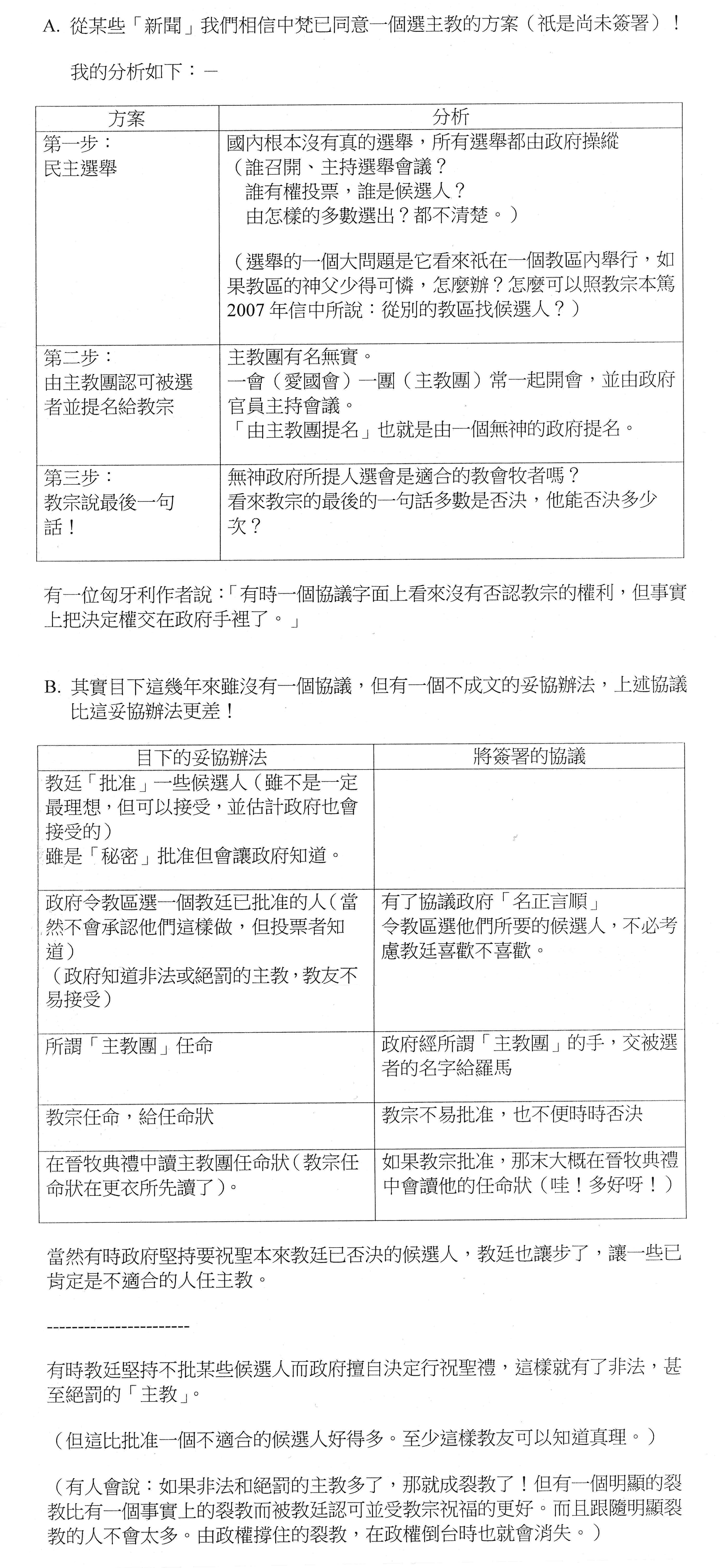
早聽說中梵談判已有成果:一個任命主教的協議已草成還未簽,我已發表意見,指出這協議是騙人的,不能接受的。

最近談判好像進入了僵局,教宗的說話也謹慎得多了,大概北京提出其他的要求他不能答應了。

但這幾天從多處來了些消息讓我非常震驚。原來他們正在推進一個邪惡的計劃:請忠貞的主教們辭職,讓非法、絕罰的「主教們」坐正!?這是一個晴天霹靂!這是教會大災禍的來臨!

有些兄弟來找我訴苦,我能說什麼?我祇能重複去年所說的:我們要爭氣,不能造反,不要讓那些站在政權那邊的人高興,說我們成了背教的。我們靜靜地到地窟裡去哭吧(有人說過「父親要我們死,我們去死吧!」他始終是我們的父親)!當然我們不能投降。那末以後不能在聖堂一起祈禱了,怎麼辦?天主在我們家裡。不能有聖事了,怎麼辦?信仰才不能缺,天主有無數方法給我們恩寵。神父們不進愛國會不能做神父了,怎麼辦?回鄉耕田吧!也不要灰心,你們永遠是神父。我不會帶領你們造反,如果那大災禍真的來到,我也會消失,我也再不能發聲了!

讓我們保留一些美好的回憶:在徐家匯聖堂,馬達欽主教說了他放下愛國會內的任務,教友們的掌聲多麼嚮亮持久!溫州朱維方主教祝聖禮中有人讀所謂「主教團任命狀」,孫振華神父走出來說:「這是什麼任命狀?祇有教宗有權任命主教!」教友們的掌聲多麼動人。難道梵蒂岡沒有聽到這些掌聲嗎?

你們或會說我今天晚上利用了紀念蔚神父的彌撒來發牢騷。不,我相信這些是今天蔚神父用我的口給你們說的話。這些話讓你們知道今天我們需求的是什麼恩寵。求主讓教廷懸崖勒馬,不要負賣我們忠貞的教會!求主給我們信德,要堅忍,要理性。冬天過後是春天。願天主永受讚美!

二零一七年十一月十日


Mass on the second anniversary of Father Wei He Ping’s death

Homily by Cardinal Zen

Today we commemorate the passing away of our dear Father Wei He Ping. After two years we are still in the dark about the real cause of his death.

Today we remember him, we miss his presence with us.

We pray, of course, for his eternal rest, as the Church recommends us to do for all the deceased not yet recognized as Blessed.

Above all, we thank the Lord for the so many wonders He has worked in Father He Ping and we offer once more to the Lord the sacrifices he and many our brothers and sisters in China, have made for their faith. For those still in “fire and deep waters” we implore divine help.

But, before God, I think it most convenient on this occasion, that we look into the dangers the faith has to face today in China, so that we may know more exactly what graces we should implore from heaven.

In the letter of Saint Paul we have just read, we are told to suffer for our faith and to fight the enemies of the faith. The gospel tells us that we cannot deny our faith, we must even be ready to offer the sacrifice of our life for it.

But today the instructions coming from Rome seem only to encourage compromise and surrender. We feel profoundly disturbed.

All these years I have told people, with daring and sadness, that the Holy See is not necessarily the Holy Father. During the years of Pope Benedict, I saw things I could never have imagined: People in the Vatican dared to manipulate the Chinese translation of Pope’s letter, they felt they could simply ignore the overwhelming majority deliberation of the highly qualified Commission set up by Pope Benedict to advise him on matters concerning the Church in China.

I had to tell people that the Holy See is not necessarily the Holy Father, otherwise they might blame the Holy Father for all the bad instructions coming from the Holy See. Those Vatican officials were not following the Holy Father. Under the guise of being obsequious, they acted as if they knew better than the Holy Father.

Before his retirement, Pope Benedict called off the negotiations and made a few personnel changes. Then comes Pope Francis, from Latin America, where he had experience of persecuted communists, but he has no experience of communists in power.

Peter Parolin was the sub-secretary of the secretariat of state for several years, head of the negotiating team with Beijing. Pope Benedict sent him to Venezuela as Nuncio, Pope Francis called him back to be his Secretary of State. Many (myself included) applauded the appointment. He seems such a nice person, quite pleasant, even with gracious talk. My admiration for him was shattered when I read a speech reported in L’Osservatore Romano, where, among other things, he used contemptuous expressions to describe (without naming them) those heroes of faith under the communist regimes in Europe, like Card. Stephen Wyszynski, Card. Mindszenty and Card. Beran. They were called “gladiators”, they “opposed the Government systematically” and “showed themselves off eagerly on the political stage”. What good can we expect from such a mindset? Instead of helping the Holy Father to correctly understand the Chinese communists, he encourage him in his optimistic illusions.

The dialogue is important and necessary. But an excessive optimism in communists, more confidence in politics than in our faith, determination to reach an agreement with Beijing at any cost, a readiness to compromise to please the other party even to the point of selling one self’s identity…this is not what the Lord desires for his Church, this is not fidelity to the Mission Jesus has entrusted to the Apostles!

The people in the Roman Curia have led the Pope to commit mistakes, even to become ridiculous. How can we not feel saddened? Recently Mr. Wang Zuo An said: “we appreciate the desire of Pope to come to China, but the conditions remain the two: Abandon Taiwan and promise not to interfere in Chinese affaires, including religious affaires.” Is this not insult to Pope Francis? They want him to go to China on his knees!

In order not to offend Beijing and damage the negotiations, Rome has not done the things which should be done. Has the Holy See demanded an explanation of the mysterious death of Fr. Wei He Ping? How could they accept not enquiring into the whereabouts of Bishop Su Zhi Min, who has been in the hands of state security for 20 years already? Many crosses were taken away forcibly from the top of the churches, and sometimes the churches themselves were demolished. Has the Vatican made a complaint? Illegitimate “bishops” and even those excommunicated are usurping sacred power, daring to perform priestly ordinations, were they duly reprimanded?

To promote dialogue, the Holy See has made many friendly gestures to Beijing, but have these been reciprocated? One excommunicated “bishop” has, twice, imposed his presence at a legitimate Episcopal ordination. Are these not slaps in the face of our Holy Father? Finally, the Holy See has practically allowed that the so called “Assembly of Chinese Catholics” should take place, what we could see is that, from the beginning to end, they shouted the slogan: “We run an independent Church, we choose and ordain our bishops”.

They dialogue with the counterpart, but the internal dialogue has been suffocated: that imposing Commission for the Church in China has quietly disappeared; they got rid of Archbishop Savio Hon Tai Fai (but they still hold him under control making him a Nuncio, given the precedents of Guam I cannot dispel from my mind the suspicion that it is their secret desire that he may make mistakes in a place so difficult as the nunciature in Greece. Should I not inform the Greek people of my suspicion?)

Bishops of the underground community, when they die, they are not given successors. Even when successors are chosen and the Bull of appointment already signed, they are told not to proceed to ordination. In the meantime the old bishop dies and the Diocese remains without an ordained bishop. In several underground communities there is only an Episcopal Delegate. It is very difficult for the Delegate to run the Diocese. Several resigned, some, obviously with encouragent from Rome, moved to join the “official” community.

Two bishops appointed with approval from both sides got themselves ordained secretly in order to avoid the presence of illegitimate “bishops” at their ordination. The Government refused to recognize them, even arrested one and, later limited his freedom of action. The Bishops stood firm, one for ten years. Now they have been “encouraged” (“ordered” ?) to concelebrate with an illegitimate bishop, and even to accept an Installation ceremony officiated by an illegitimate “Bishop”. You can imagine (or see in the photos) the sadness and indignation on the faces of their priests.

It seems common knowledge that an agreement on the appointment of bishops is ready but not yet signed. From what we can ascertain, it is all fake and unacceptable. Recently the negotiation seems to be at an impasse. The Pope seems more cautious in his expressions, probably he cannot make other concessions to please Beijing.

But suddenly, news from many parts come which are terrible: an evil plan seems to be in play. Legitimate bishops are being asked to resign in order to facilitate the recognition of illegitimate and even excommunicated “bishops”. Lightning strikes on a sunny day. It’s the beginning of the end!

People come to confide to me their worries and despair. What can I tell them except to repeat my appeal last year: “keep our faith with dignity. No rebellion. We are not to give satisfaction to those who are laughingly telling us: you papists are going to be apostates! Let’s go to shed our tears silently in the Catacombs (long time ago I have read the internet “our enemies could not make us to die. Now our father wants us to die. O.K. let’s go to die. He is our father”).

Obviously, we can die but not surrender. Then, we may not be able to have a place to pray together? The Lord comes to our home! The faithful may have no more sacraments? The faith only is essential. God has thousands of ways to gives us His grace! We can no more function as priests if we don’t join the Patristic Association!? Go back to till the soil, you will always be priests.

Dear brothers, I will not lead a rebellion. If the tragedy comes, I will disappear and retreat into prayer and penance.

Some memory may comfort us in our (seeming) defeat. When, at the end of his Episcopal ordination Ma Daqin announced that he would relinquish his post in the Patriotic Association, a long and thunderous applause filled the church. Similarly during the ordination of late Bishop Zhu, when a so called decree of nomination from the Bishops’ Conference was being read, Fr. Shun snatched the document and said, “what is this? Only the Pope can nominate bishops”, the people applauded. Did the Vatican the applause? Let’s cherish in our heart the voice of the People of God!

Dear faithful, some of you may say that I am using this Mass commemorating Fr. Wei He Ping to vent my anger. No, I am sure: from heaven tonight our beloved Fr. He Ping wants to tell you just what I have said. Now you may know more precisely what grace we need to ask from the almighty.

Let our prayer be: O Lord, bar our leaders in Rome from the precipice, from the betrayal of our faithful Church in China, and to us the perseverance in the faith and the wisdom to resist the temptation of rebellion!

The spring follows the winter. May the Lord be always blessed!


Messa del secondo anniversario del Padre Wei He Ping

Omelia del Card. Giuseppe Zen

Oggi commemoriamo il nostro caro Padre Wei He Ping. Due anni fa, in circostanze misteriose, ci ha lasciato. E non si è ancora fatta luce sulla vera causa della morte. Noi oggi lo ricordiamo e sentiamo la mancanza della sua presenza in mezzo a noi. Naturalmente preghiamo anche per il suo eterno riposo, così la Chiesa ci dice di fare per i defunti non ancora dichiarati Beati. Penso che dobbiamo soprattutto lodare il Signore per le cose meravigliose che ha fatto nella persona di questo nostro fratello. Ancora una volta offriamo i suoi sacrifici e quelli di tanti nostri fratelli e sorelle in Cina per la loro fede. E preghiamo per quelli che sono ancora nella terribile persecuzione.

Ma, davanti a Dio, penso che sia conveniente in questa occasione analizzare i pericoli che in questo momento stanno minacciando la Chiesa in Cina, e questo affinchè sappiamo precisamente quale grazia dobbiamo chiedere al Signore.

La Lettera di San Paolo che abbiamo sentito leggere ci dice che dobbiamo soffrire per la fede e che dobbiamo combattere contro i nemici della fede. Il Vangelo ci dice che noi non possiamo negare la fede e che dobbiamo perfino essere disposti a lasciare la vita per essa. Ma le istruzioni che vengono da Roma sembra che incoraggino sempre il compromesso e la resa. Come possiamo non sentirci turbati?

In questi anni, con audacia e con dolore, dico che la Santa Sede non è sempre il Santo Padre. Durante gli anni di Papa Benedetto ho visto cose incredibili. Hanno osato manipolare la traduzione cinese della Sua Lettera. Hanno ignorato semplicemente l’opinione pesantemente maggioritaria della Commissione che il Santo Padre aveva istituito per la Chiesa in Cina. Non seguivano il Papa. Io dico questo per evitare che si creda che tutte le istruzioni da Roma vengano dal Papa. Purtroppo i Suoi ufficiali, fingendo di esserGli obbedienti, fanno come se conoscessero le cose meglio del Papa.

Prima del Suo ritiro dall’ufficio, Papa Benedetto ha fermato ogni cosa ed ha anche fatto cambiamenti di personale. Viene Papa Francesco, dall’America Latina, dove ha conosciuto i comunisti perseguitati, ma non ha avuto esperienza di comunisti al potere.

Egli ha nominato il Suo Segretario di Stato. Costui era il sottosegretario della Segreteria di Stato e per molti anni capo della delegazione che andava a negoziare col Governo cinese. Venne mandato nel Venezuela da Papa Benedetto come Nunzio e Papa Francesco lo richiama a Roma in qualità di Segretario di Stato. La nomina è stata applaudita da molti. Egli appare una persona compita, io direi addirittura piacevole, perfino  melliflua. Io pure avevo fiducia in lui, fino a quando sull’ Osservatore Romano ho visto un suo discorso, in cui descriveva gli eroi della fede del Centro Europa sotto i regimi comunisti come “gladiatori”, “gente che si oppone sistematicamente al Governo”, “gente che ama farsi bella sul palcoscenico politico” (non ha negato che intendeva il Card. Stefan Wyszyński, il Card. József Mindszenty e il Card. Josef Beran.) Cosa ci si può aspettare da una tale mentalità? Invece di aiutare il Papa a capire meglio i comunisti cinesi, egli lo ha incoraggiato a correre sulla via dell’ottimismo.

Il dialogo è importante e necessario. Però, un ottimismo eccessivo nei riguardi dei comunisti, una stima dell’arte diplomatica più che della fede, una volontà di arrivare ad un accordo ad ogni costo, la disponibilità senza limiti al compromesso per piacere all’avversario fino a vendere se stesso… Questo certamente non è quello che il Signore si aspetta dalla Chiesa, non è fedeltà alla missione che Gesù ha affidato agli Apostoli.

La Curia ha condotto il Santo Padre a commettere errori e perfino a rendersi ridicolo. Come possiamo non sentirci addolorati? Recentemente il Sig. Wang Zuo An dice: “Noi apprezziamo il desiderio del Papa di venire in Cina, ma le condizioni sono ancora queste due: Abbandonare Taiwan e non interferire negli affari interni, compresi quelli religiosi.” Ma questo non è insultare il Papa, chiedendogli di andare a Pechino in ginocchio?

Per non offendere Pechino e perdere l’opportunità di dialogo, si è rinunciato di fare tante cose che si debbono fare. Per il misterioso “suicidio” del Padre Wei He Ping, la Santa Sede ha chiesto una spiegazione a Pechino? E come possono accettare di non parlare neanche di come si trova il Vescovo Jacobus Su Zhi Min scomparso da 20 anni? Tante croci sono state tolte dalla cima delle chiese e anche chiese stesse demolite. Il Vaticano ha detto qualcosa? Vescovi illegittimi e scomunicati, abusando del potere sacro, hanno ordinato sacerdoti. Sono stati ammoniti dalla Santa Sede?

Si intensifica il dialogo. La Santa Sede continuamente fa gesti di buona volontà. Ma è stata contraccambiata da Pechino? Un vescovo scomunicato ha due volte partecipato a ordinazioni episcopali legittime. Non sono due schiaffi al Papa? La Santa Sede ha praticamente permesso che si tenesse la quinquennale Assemblea dei Rappresentanti dei Cattolici Cinesi, in cui dall’inizio alla fine si è gridato di essere una Chiesa indipendente e di avere diritto di ordinazioni episcopali senza il mandato del Papa.

Si dialoga col nemico, ma si soffoca il dialogo interno: la Commissione per la Chiesa in Cina è scomparsa silenzionsamente. Dell’ Arcivescovo Savio Hon Tai Fai si sono sbarazzati. (Però lo tengono ancora al guinzaglio e, dati i precedenti di Guam, non posso togliermi il sospetto che si augurino che egli commetta degli errori, ma in tal caso non dovrei comunicare il mio sospetto alla Comunità Cattolica in Grecia?)

Vescovi fedeli alla Chiesa invecchiano, ma non vengono dati loro successori. Qualche volta i successori sono nominati, esiste addirittura già la Bulla di nomina, ma all’ultimo momento si dice: “Non fate l’ordinazione.” Intanto, il vecchio Vescovo perde l’uso delle sue facoltà e poi lascia il mondo. In parecchie diocesi della Comunità clandestina c’è solo un Delegato episcopale. Ma questo non funziona. Molti Delegati si dimettono. Altri, incoraggiati dalla Santa Sede, vanno a “unirsi” con l’altra Comunità.

Alcuni Vescovi legittimi, ordinati segretamente per non subire la presenza di vescovi illegittimi all’ordinazione,  non vengono riconosciuti dal Governo. Essi però resistono, anche fino a dieci anni, ma ora vengono incoraggiati dalla Santa Sede, per essere riconosciuti, ad accettare di concelebrare con vescovi illegittimi od a subire una istallazione officiata dal vescovo illegittimo. Possiamo immaginare (anche vedere sulle foto) come i loro preti siano tristi e indignati in tali circostanze.

Si viene a sapere che i negoziati hanno già un frutto: un accordo per la nomina dei vescovi, accordo già approvato ma non firmato. Da quel che si può sapere l’accordo è ingannevole, inaccettabile. Recentemente si ha l’impressione che i negoziati siano in una situazione di stallo. E le parole del Santo Padre sono molto più caute di prima. Probabilmente Pechino ha fatto altre domande a cui il Papa non può acconsentire.

Ma in questi giorni, da più parti arrivano notizie spaventose. Stanno eseguendo un piano, semplicemente malvagio, di chiedere a Vescovi legittimi di dimettersi per fare posto a vescovi illegittimi e scomunicati che diventeranno Vescovi Ordinari della Diocesi. È un fulmine a ciel sereno. È l’inizio della fine.

Dei fratelli vengono a confidarmi le loro pene. Cosa posso dire? Posso solo ripetere ciò che ho detto l’anno scorso in un mio appello: “Teniamo onore alla nostra fede. Non possiamo ribellarci. Non facciamo contenti i malvagi che sghignazzano dicendo, ‘Vedrete questi papisti diventare apostati’. In silenzio andiamo a piangere nelle catacombe.” (Tempo fa qualcuno aveva detto sull’Internet: “I nostri nemici non sono riusciti a farci morire. Ora è il nostro Padre che ci vuole morti. Va bene. Andiamo a morire. È nostro Padre”).

Ovviamente non possiamo arrenderci. Allora, non avremo più chiese dove pregare insieme. Il Signore viene nelle nostre famiglie. Non avremo più Sacramenti. La fede è più fondamentale dei Sacramenti, il Signore ha mille modi per darci la sua grazia. I preti, se non entrano nell’Associazione Patriottica, non possono più agire come preti. Non importa. Tornate a zappare la terra. Sarete sempre preti. Io non capeggerò una rivoluzione. Se la tragedia scoppia, anch’io mi ritirerò nel silenzio.

Teniamo qualche bel ricordo: a Xu Jia Hui, quando Ma Da Qin ha detto di lasciare i suoi incarichi nell’Associazione Patriottica, c’è stato un applauso lungo e fragoroso. A Wenzhou, durante l’ordinazione del Vescovo Zhu, quando il Padre Shun è andato a strappare il cosiddetto decreto di nomina della cosiddetta Conferenza Episcopale, dicendo che solo il Papa può nominare i vescovi, un simile applauso è risuonato nella chiesa.

Il Vaticano non ha sentito queste voci del Popolo di Dio?

Cari fedeli, direte che ho sfruttato questa Messa di ricordo del Padre Wei He Ping per dare sfogo al mio malcontento? No, io credo che il Padre He Ping stassera avrebbe detto quello che or ora io ho detto a voi. Così saprete quale grazia dobbiamo chiedere al Signore. Preghiamo il Signore che gli ufficiali della Curia a Roma si fermino davanti al precipizio, che non tradiscano la Chiesa fedele, e per noi stessi chiediamo perseveranza nella fede e moderazione del nostro istinto di ribellione.

Dopo l’inverno ci sarà la primavera.

Il Signore sia sempre benedetto.
La posizione della Santa Sede circa l’Assemblea dei Rappresentanti dei Cattolici Cinesi

A metà Dicembre, quando Gianni Valente ci diede la notizia dell’imminente Assemblea dei Rappresentanti dei Cattolici Cinesi, ha riconosciuto giustamente che essa è “l’organismo più alto tra gli apparati che applicano la politica religiosa delle Autorità Cinesi alla Chiesa Cattolica”. Con parole più chiare si deve dire: essa è “l’espressione più formale ed esplicita della natura ‘scismatica’ di quella Chiesa”. Conseguentemente mi sono domandato: come può la Santa Sede acconsentire che essa abbia luogo?

Ora arriva una Dichiarazione ufficiale della Santa Sede. Essa “attende di giudicare (l’Assemblea) in base a fatti comprovati”, sottintendendo che la Santa Sede  tollera la sua convocazione e permette ai Cattolici Cinesi di prendervi parte.

La Dichiarazione dice che “è nota da tempo la posizione della Santa Sede circa …l’Assemblea che implica aspetti della dottrina e della disciplina della chiesa.”

Confesso che mi fa difficoltà a capire quale sia questa nota posizione della Santa Sede.

Se la memoria non mi inganna, nel 2010, prima della Ottava Assemblea, la Commissione Pontificia per la Chiesa in Cina, in un suo Communicato, ovviamente approvato dal Santo Padre, vietava ai vescovi di prendervi parte (in piena consonanza con la lettera del 2007 di Benedetto).

Dunque la Dichiarazione di oggi rinnega il Comunicato del 2010?

Se uno ritiene ancora valido il Comunicato del 2010 (perchè la natura di quell’Assemblea risulta oggettivamente “scismatica”), come può prendervi parte? Non sarebbe cooperazione diretta e formale in azione gravemente peccaminosa?

I redattori della Dichiarazione hanno consultato il parere della Congregazione della Dottrina (i suoi capi, presente e del recente passato) e quello degli esperti in diritto canonico (membri della Commissione ed i loro predecessori)? La gravità della materia richiederebbe.

——————————————————————————————————-

Tornando alla Dichiarazione: quali “fatti” si ripromettono gli ufficiali del Vaticano di “comprovare”? Non sanno come si è sempre proceduto in tali Assemblee? Esse sono orchestrate totalmente dal Governo, anche se manda a presiederla un laico, Mr. Liu Bai-nian.

I membri dell’Assemblea sono tutti i vescovi riconosciuti dal Governo, più rappresentanti di sacerdoti, suore e laici (non si sa in quale proporzione numerica e attraverso quale modo di elezione).

Dopo qualche discussione “orchestrata” l’Assemblea può approvare qualunque Deliberazione come e.g. modifiche alle Costituzioni dell’Associazione Patriotica e della Conferenza Episcopole.

Ma il compito principale dell’Assemblea è di eleggere i quadri diligenti per i prossimi cinque anmi: Presidente e vice-presidenti dell’ Associazione Patriotica e della Conferenza Episcopale (Però i candidati sono già alla tavola di Presidenza fin dall’inizio dell’Assemblea).

La Santa Sede si aspetta radicali cambiamenti di questa procedura?

La Dichiarazione dice: “tutti … attendono … segni positivi (da questa Assemblea)”. Ma quali “segni positivi”? Che il governo dichiari di rinunciare al suo controllo ed interferenza nelle cose interne della Chiesa Cattolica? Oppure che i partecipanti, con a capo i vescovi, facciano una rivoluzione dichiarando che d’ora in poi obediranno al Papa e non più al governo ateo? (Senza una probalilità di ottenrere tali risultati non si giustifica la presenza a tali assemblee). Ma data la recente linea dura del Goverso nel trattare la Chiesa e la sempre maggiore arrendevolezza di molti vescovi (con comprensione e perfino incoraggiamento della Santa Sede), c’è anche solo un barlume di possibilità di tale rivoluzione?

Gianni Valente parlava di “dare fiducia ai vescovi”. Ma richiedere che siano degli eroi, non è piuttosto ingiusto? In comparazione è molto più facile scappare e boicotare l’Assemblea che iniziare una rivoluzione dentro l’Assemblea! Nell’ Assemblea saranno gli elementi opportunisti a parlare piuttosto e in sostegno del Governo.

Tra l’altro per poter comprovare i fatti bisogno che ci sia testimonianza credibile. Chi ci fornirà informazione fedele alla realtà? I media saranno ammessi?

——————————————————————————————————-

La stessa Convocazione dell’Assemblea non è già an segnale più che evidente della posizione indurita del Governo e della sua totale mancanza di buona volontà? Vuole una incondizionata sottomissione. Come possiamo aver fiducia nel corrente dialogo?

Sono io troppo pessimista? Spero che i fatti mi provino tale. Sarei felice di vedere fallire tutte le mie pessimitiche previsioni, anche se sarò oggetto di scherno per questo. Come ogni cattolico cinese spero che la Chiesa in Cina abbia un futuro di unità ed armonia, ma l’unità nella verità e l’armonia nella libertà. A suo tempo Nostro Signore Gesù Redentore ce lo concederà. Ma per questo Natale dobbiamo pregare di più ed anche digiunare.

Il Sole che sale dall’Oriente ci porti luce e calore!

Maria e Giuseppe, accompagnateci nel pellegrinaggio!

Giovanni Battista che dicesti “No” ad Erode, prega per noi!

Stefano che morente hai visto il cielo aperto e Nostro Signore nella Gloria, prega per noi!

Chinese Version

聖座怎麼看「中國天主教代表大會」?

English Version

The position of the Holy See regarding the Assembly of Chinese Catholic Representatives


The position of the Holy See regarding the Assembly of Chinese Catholic Representatives

In the middle of December, when Gianni Valente broke the news of the imminent Ninth Assembly of Chinese Catholic Representatives, he rightly qualified it as “The Highest Organism which executes the Religious Policy of the Chinese Authorities for the Catholic Church”.

In more clear words we may say that: it is the most formal and explicit manifestation of the schismatic Nature of the Church in China.

Consequently I asked the question: How can the Holy See just let it take place?

Now comes the Official Declaration from the Holy See. It says that the Holy See “is waiting for hard facts before it makes a judgment”. That means the Holy See would let the Assembly to take place and allow the Catholics to take part in it.

The Declaration says “the position of the Holy See regarding this Assembly is well known”. I have to confess that I have difficulty to understand what that position is exactly.

I remember, in 2010, before the Eighth Assembly, the Pontifical Commission for the Catholic Church in China had issued a communiqué, which obviously had the Pope’s approval, telling the Bishops not to take part in it.

So the Declaration differs from the Communiqué?

If one holds on the communiqué of 2010 (because the mature of the Assembly is objectively “schismatic”) how can he take part in it? Is it not an act of direct and formal cooperation in grivious sin?

Have the people responsible for the Declaration consulted the opinion of the Congregation for the Doctrine (present and past Prefects) and experts in Canon Law (present and former members of the Commission)? The seriousness of the matter seems to demand it.

————————————————————————————————-

Coming back to the Declaration: what “hard facts” they are waiting to see? Don’t the people in Vatican already know the working of those Assemblies?

Everything is controlled by the Government. They used to appoint a lay person, Mr. Liu bai-nian, to preside. The members include all the bishops recognized by the Government, plus representatives from priests, nuns and laity (in what proportion in number compared with the bishops? With what kind of election are they chosen?)

They have authority to pass deliberations, e.g. to modify the Constitutions of the Patriotic Association and of the Bishops’ Conference, after some “fake” discussion.

Their main job is to elect the leadership of the Church for the coming 5 years: President and vice-presidents of the Patriotic Association; President and vice-presidents of the Bishops’ Conference (All the candidates are already seated at the presidential table from the beginning of the Assembly).

Does the Holy See expect radical changes of this procedure?

The Declaration also says: “all the people are waiting to see some positive signals (from the Assembly). What positive signals do they expect to see? That the Government decides to relinquish their control and interference in the internal affairs of the Catholic Church? That the Assembly, led by the Bishops, puts up a “revolution”, swear their loyalty to the Pope and no more to the Atheist Government? (Without a good probability to get these facts there is no sufficient justification for taking part in such Assembly.)

But given the recent tightening of Government Religious policy and increasing tendency to compromise in several bishops (with understanding or even encouragement from the Holy See), there seems to be not even a minimum of possibility of such a revolution.

Gianni Valente talks about “trusting the bishops”. But here you are demanding heroism. Is that fair? In comparison it is much easier to get away and boycott the Assembly than to start a revolution in it. In the Assembly the “opportunists” will raise their voice to support the Government.

Then to judge by facts you need to have reliable information, can you get it? Are the media admitted into the Assembly?

——————————————————————————————————-

Is not the Assembly itself taking place already a most evident signal that the Chinese Government is taking a hard position, showing no good will? They simply demand a total surrender. Can we nourish any hope in a good conclusion of the Sino-Vatican talks?

Am I an extreme pessimist? I would like to be proved as such by facts. I would be happy it all my pessimistic prophesies fail and get scorned by my foes. As every Catholic faithful I long for a future of unity and harmony for our Church in China, but a unity in the truth and a harmony in freedom. Our Lord Redeemer will surely grant it to us in His good time. In the meantime for this Christmas time we have better to pray more and give ourselves to fasting.

May the Rising Sun from the East bring us light and warmth!

May Mary and Joseph be our companions in this pilgrimage!

John the Baptist, you said “No” to Herod, pray for us!

Stephen, dying you saw the Heaven opened and the Lord in glory, pray for us!


Italian Version

La posizione della Santa Sede circa l’Assemblea dei Rappresentanti dei Cattolici Cinesi

Chinese Version

聖座怎麼看「中國天主教代表大會」?

聖座怎麼看「中國天主教代表大會」?

在十二月中旬詹尼‧瓦倫特(Gianni Valente)告訴我們「中國天主教代表大會」即將舉行。他承認這代表大會是「中共當局對天主教會實施宗教政策的最高機構」。更清晰地該說:那大會「最正式,最真接地,表達出國內地上教會實質上處於裂教狀態」。所以我問瓦倫特:聖座怎麼可以同意它召開?

現在聖座出了書面聲明:說在對此大會做出判斷前「要先看確定的事實」,那也就是說聖座讓它召開並允許中國天主教成員參與。

聲明說:「眾所周知聖座對這大會,從教義和紀律角度看來,持什麼立場。」恕我無知,我真不明白聖座持的是什麼立場。

如果我不記錯,在2010年第八屆大會召開前,聖座的中國教會事務委員會出了文告(當然得到教宗同意)吩咐主教們不要參與那會議(這無非忠於教宗2007年的牧函)。

那末今天聖座的聲明推翻了昔日的文告

如果有教友堅信2010年的文告仍舊有效(因為該大會的性質客觀上實屬裂教)他們怎麼能參與?這豈不是在嚴重罪行上作出直接、正面的合作?

在這嚴重的問題上有關方面不知有否諮詢信理部現任及前任部長,還有一些教會法典專家的意見?

—————————————————————————————————–

回到這次的聲明:梵蒂岡的官員究竟期待能「看到」些什麼「事實」?難道他們不知道大會是怎麼樣進行的嗎?這類大會一向全部由政府安排。由一位教友「劉柏年」主持。成員包括全體主教及一些神父、修女及教友的代表(代表如何選出,人數和主教成什麼比例,無從而知)。他們經過「假討論」後通過一些議案(議案可以修改愛國會及主教團的章程)。他們的主要任務是選舉「一會一團」的主席和數位副主席(而那些候選者在會議開始時早已坐在主席台上)。聖座期待這次會議的進展會徹底不同嗎?

聲明又說國內教徒都期待(從這會議)見到一些積極的訊號。什麼「積極的訊號」?政府宣佈放手不再干涉,操縱中國教會內政嗎?或者與會教徒在主教們領導下發起革命,宣佈從此服從教宗不再服從無神政府嗎?(因為如沒有把握得到如此效果,看不到可有什麼理由接受參加這會議。)但政府近來宣佈會更嚴格控制教會,多數主教又越來越順服政府(且在這態度上得到聖座的諒解甚或鼓勵),上述「革命」有些微成功的可能嗎?

瓦倫特說聖座要「信賴」與會的主教們。但要求這些主教做英雄,公道嗎?「杯葛」會議豈不比在會議中作反容易得多?在會議中那些「投機份子」肯定會積極發言,支持政府。

其實為能看到「確定的事實」及「積極的訊號」必須有可信的見證。人們從哪處能得到可靠的消息?傳媒被准許在場收集資料嗎?

—————————————————————————————————–

其實政府堅持召開這大會根本就是一個清晰的信號:它強橫無理,不示任何善意,簡直是要梵方屈服,叩頭。這讓我們對中梵談判能有信心嗎?

是我太悲觀了嗎?我希望事實證明我真的太悲觀。如果我悲觀的預測都錯了,就算我因而受大眾辱罵,我也會很高興。我和所有信徒一樣希望在祖國的教會有個「合一且和諧的將來」;一個在真理中的合一,在自由中的和諧!救主耶穌在祂所定的時刻一定會賜給我們。但今年的聖誕期我們還是多多祈禱和守齋吧!

東方昇起的旭日,請帶來光明溫暖!

瑪利亞、若瑟,請照顧旅途中的教會!

向黑落德說「不」的若翰洗者,為我等祈!

見天開了,見人子站在天主右邊的斯德望,為我等祈!


Italian Version

La posizione della Santa Sede circa l’Assemblea dei Rappresentanti dei Cattolici Cinesi

English Version

The position of the Holy See regarding the Assembly of Chinese Catholic Representatives

After those slaps in the face…?

Recently the words “slaps in the face” appeared rather frequently on chinacath.org.

One ridiculous case was when a certain Mr. Liu said that Chris Patten, during his recent visit to Hong Kong, gave me a slap in the face. The fact is that Chris Patten severely criticized the position of those who want Hong Kong to be independent from China. But I never supported that position. (I even criticized the students for their impulsive actions).

I can imagine the embarrassment of that ridiculous fellow, if I tell him that Chris Patten, before he concluded his visit, accepted to have lunch with me (we chatted for three hours)!

In another case, much more serious, someone said that when an excommunicated “bishop” took part, twice, in episcopal ordinations in Sichuan, China, it was as if they had given a slap in the face of our Holy Father. Yes, and it must sadden every Catholic who loves Pope Francis.

How could the Chinese government allow, or even encourage “Bishop” Lei Shiyin to do such a thing? How can we still believe that the Chinese negotiators have good will when talking to Vatican officials?

(It shocks me that no word of protest has come from the Vatican yet, till this moment, 12 December).

Reading a comment by Gianni Valente (Vatican Insider 30 November), I am happy to find out that, on this point, he feels the way I do. Did those “slaps” awaken him from his optimistic dream? Maybe he did not really feel as if he himself had been slapped. He was only half awakened. Why do I say so?

Gianni Valente gave us the information that “the IX General Assembly of Catholic Representatives in China is going to be convened soon.” He reported also, with obvious consent, the opinion of some Chinese bishops: “the participation in an illicit episcopal consecration is not to be judged as of the same gravity as the eventual presence at a national Congress, which is convoked by the Government, so it has nothing to do with the spirit of the Church.” [Probably they want to say “The presence at a national Congress is not to be judged as of the same gravity as the participation in an illicit episcopal ordination”.]

It’s incredible that such absurdity could be uttered by somebody. Gianni Valente himself in the same article has affirmed that this Assembly is “the highest authority governing the Church in China”. We may say: it is surely the most formal and explicit expression of the schismatic nature of that poor Church!!!

I ask the question: how could Gianni Valente suggest the idea that the Assembly could be allowed to be convoked. That is exactly what he is saying: “the recent history has shown that the problem is not resolved by putting pressure on Chinese Bishops (preventing them from joining the Assembly). It also shows that they are called, with the Holy See’s trust in them, to ensure with their speeches that the Assembly does not implement any action that may be contrary to the sacramental nature and great discipline of the Church.”

I cannot believe that Gianni Valente be so naïve as to believe what he said. He is saying, practically, that the Vatican should allow the Assembly to take its place and, in it, let the bishops make a revolution changing completely the present situation (because the actual situation is totally contrary to the doctrine and discipline of the Catholic Church).

Since Gianni Valente is talking about the recent history and particularly about the Assembly of 2010, I feel qualified to join the discussion because of my knowledge of the facts.

I do not know whether the Holy See has ever, before 2010, told the bishops not to join the Assembly. Anyway is it realistic to expect the bishops to do something inside the Assembly? Not even the heroic Bishop Li Duan succeeded!

In 2010 the Commission for the Church in China had finally seen the need of a change of strategy: tell the bishops simply not to join it. (The communiqué had obviously been approved by the Holy Father).

Was the Commission expecting that all the bishops would comply with the instruction? Probably not, but certainly a good number of them. And that would be enough to make the Government postpone again the Assembly (they did that already more than once) may be, “sine die” this time. The communists do not take risks when they are not sure of success.

How did the Assembly take place in 2010? The three bishops, mentioned by Gianni Valente, confided their difficulties not only to UCAN, but also to the Vatican Cardinal in charge of the Church in China, and the reply by His Eminence was: “we understand”.

The voice spread, everybody knew that is was the Cardinal, not the Commission, in command. The Government summoned the Assembly, since they still had a little fear that some surprise could happen, they used force, bringing “physically” several rappresantatives to the venue of the Assembly.

What would have happened without that “we understand”? Nobody may be able to tell, but one thing is certain: the following history would have been very different.

But why should we always ask: “what is going to happen?”, and not ask “what must we do?” When facing an evil action, why do we look for reasons which may justify our tolerance, rather than take the decision not to give our collaboration?

Coming back to those recent Episcopal Ordinations marred by the presence of the excommunicated “bishop”, why did the bishops present not dare to ask that “brother” to leave the place and insist on not carrying on the rite until he complied? Would their life have been in danger? Would they all have seen arrested? I don’t think so.

In 2000 Bishop Li Duan dared to disappear twice: fist, when, in January, they called him to take part in the mass illegitimate ordination, and then, in September, when they called him to Beijing to sign the letter of protest to the Pope against the Canonization of the martyrs in China. He was punished, yes, but not stripped of his office, and not arrested either.

Between 30 Nov and 2 Dec. there was enough time for a word of protest. People may say: “That would not have changed the events”. But, then, once more an act of “disdain for the Petrine and Episcopal Ministry” (Benedict’s letter 2007, sec. 8) was allowed to be committed.

Often I have been accused of pushing my brothers to martyrdom while enjoying freedom and security myself. In these days the readings in the liturgy come to my aid. Jesus said, referring to John the Baptist: “What did you go out into the wilderness to see? A reed swaying in the breeze? … the kingdom of heaven has been subjected to violence and the violent are taking it by storm.” (Mt. 11: 7, 12)

Before we contemplate the tender face of the Divine Infant let us look at the glorious Lord coming to separate the sheep from the goats.

It is cruelty to make our brothers be “reconciled” with their slavery. True charity consists in helping them to free themselves. The strength will come from the Holy Spirit.

The Ostpolitik strategy was a failure (Pope Benedict XVI – “The Last Conversations”) Try, please, this other strategy, the evangelical strategy, before it’s too late!

Chinese Version:

這兩個巴掌還不夠痛嗎?

Italian Version:

Non sono bastati quegli schiaffi?

Non sono bastati quegli schiaffi?


In questi giorni sul “chinacath.org” corre sovente la parola “schiaffo”. Qualcuno dice che Chris Patten (l’ultimo Governatore della Colonia Britanica, cattolico praticante), durante la sua recente visita a Hong Kong, mi ha dato uno schiaffo.

Il fatto è che C. P. ha parlato chiaramente contro il movimento di “Indipendenza di Hong Kong dalla Cina”, che sperava in un suo appoggio. Ma io non ho mai sostenuto tale movimento, anzi, non avevo nemmeno sostenuto le azioni impulsive degli studenti, i quali anche se hanno il merito di aver attirato l’attenzione mondiale su H.K., hanno reso impossibile l’originario piano di “Occupy Central” dei tre promotori, ai quali avevo invece dichiarato la mia adesione.

Sarà un’imbarazzante sorpresa per quel mio “amico” sapere che Chris Patten, l’ultimo giorno della sua visita, ha pranzato con me ed il pranzo è durato 3 ore.

Altri, sullo stesso “chinacath.org” hanno parlato di “schiaffo”, ma in un caso molto più serio, dicono che la Cina ha dato uno schiaffo al nostro Papa con la presenza di un “Vescovo” scomunicato alle recenti ordinazioni episcopali. È triste, ma vero.

Come ha potuto il Governo cinese permettere, o addirittura incoraggiare, il “vescovo” scomunicato a partecipare alle ordinazioni episcopali? Come si fa a credere alla loro “buona volontà” al tavolo del dialogo con ufficiali del Vaticano? (Se non mi sbaglio, il Vaticano non ha neanche accusato il colpo, almeno fino a questo momento: il 12 Dicembre).

Intanto vedo che su ciò è d’accordo con me, una volta tanto, il già mio amico Gianni Valente (v. l’articolo del 30 Nov. sul Vatican Insider). È stato svegliato dal suo sogno ottimistico? Nel qual caso ci sarebbe da dire che non tutti i mali vengono a nuocere. Sembra, però, che lo schiaffo non l’abbia sentito come fosse sulla propria pelle, lui che so essere tanto amico di Papa Francesco, e non l’ha svegliato del tutto.

Dando notizia della prossima IX “Assemblea Generale dei Rappresentanti dei Cattolici cinesi”, egli riporta, con evidente senso di approvazione, l’opinione, dice lui, di alcuni vescovi in Cina: “La partecipazione a un’ordinazione illecita non poteva essere equiparata per gravità a un eventuale atto di presenza a un congresso nazionale ‘che non ha niente a che fare con lo spirito della Chiesa’ essendo convocato dal Governo”. (Sono sicuro che volevano dire” un’eventuale atto di presenza a un congresso nazionale non poteva essere equiparata per gravità alla partecipazione a un’ordinazione illecita”).

Non pare vero che qualcuno abbia potuto proferire tale assurdita! Poco prima, nello stesso articolo, G.V. aveva detto che quell’Assemblea è “l’organismo più alto tra gli apparati che applicano la politica religiosa delle autorità cinesi alla Chiesa Cattolica”. Difatti essa è l’espressione più formale ed esplicita della natura “scismatica” di quella povera Chiesa!

Conseguentemente mi domando: come può G.V, insinuare che la Santa Sede debba passivamente tollerare il fatto che essa abbia luogo? Egli dice infatti: “la storia recente ha confermato che il problema non si risolve faccendo pressione sui vescovi cinesi (di non parteciparvi). E che proprio loro, con la fiducia della Santa Sede, sono chiamati coi loro interventi (dentro l’Assemblea) a garantire che i lavori dell’Assemblea non pongano in atto disposizioni contrarie alla natura sacramentale e alla grande disciplina della Chiesa.”

Non mi è possible credere che G.V. sia cosi ingenuo da credere ciò de serive. Sta dicendo, infatti, in altre parole, che il Vaticano deve lasciare che l’Assemblea venga convocata e che, in essa, i vescovi facciano una rivoluzione rovesciando la situazione presente (perchè questa è totalmente contraria alla dottrina e disciplina della Chiesa)!

Siccome G. V. parla della storia recente, dell’Assemblea del 2010, posso parlarne anch’io con conoscenza dei fatti.

Non so se sia vero che prima del 2010 la Santa Sede non abbia mai chiesto ai vescovi di non andare all’Assemblea. Ma era realistico aspettare che i vescovi possano fare qualcosa dentro l’Assemblea, se neanche l’eroico Mons. Li Duan ci è riuscito? Nel 2010 la Commissione ha finalmente creduto necessario adottare una diversa strategia: dire ai vescovi di non andare all’Assemblea (il communicato aveva ovviamente l’approvazione di Papa Benedetto).

La commissione sperava che tutti i vescovi avrebbero accettato tale disposizione? Non tutti, ma probabilmente una buona parte, e questo sarebbe bastato perchè il governo tramandasse ancora una volta l’Assemblea (l’avevano già tramandato pìu di una volta), questa volta forse “sine die”. I Communisti non rischiano, quando non sono sicuri di riuscire.

Allora come mai l’Assemblea è stata convocata? I tre Vescovi, di cui parla G.V., non solo hanno confidato le loro difficoltà all’UCAN, ma le hanno presentate all’ Eminentissino a cui appartiene il disbrigo degli affari della Chiesa in Cina e l’Eminenza rispose “noi comprendiamo”.

La voce si è subito sparsa e tutti sanno che è l’Eminentissimo che comanda e non la Commissione. Il Governo ha convocato senz’altro l’Assemblea, ma con ancora un pò di timore di sorprese, per cui, come narra pure G.V., hanno portato, quasi “di peso”, i rappresentanti alla sede dell’Assemblea.

Che cose sarebbe avvenuto senza quel “noi comprendiamo”? Nessuno è in grado di saperlo con sicurezza. Sicuramente, però, la storia seguente sarebbe stata molto diversa.

Ma il punto è: perchè dobbiamo sempre domandare “che cosa succederà” e non “che cosa dobbiamo fare”? Davanti ad una cosa cattiva perchè cerchiamo sempre ragioni per tollerarla piuttosto di prendere la coraggiosa decisione di rifiutare la nostra collaborazione?

Torniamo alle ordinazioni Episcopali recenti coinquinate dalla presenza dello scomunicato. Perchè i vescovi presenti non hanno osato dire a quel “fratello” di andarsene e dirsi pronti, altrimenti, a cancellare il rito? Correvano il pericolo per la vita? Li avrebbe arrestati tutti la polizia? Non credo.

Nel 2000 Mons. Li Duan ha osato “scomparire” sia dall’ordinazione episcopale illecita del 6 gennaio, sia quando i vescovi sono stati convocati a Pechino a firmare una lettera di protesta contro il Papa per la canonizzazione dei Martiri in Cina. Eppure il Santo Vescovo ha subìto punizione sì, ma non lo hanno spodestato, tanto meno arrestato.

Eppoi, tra il 30 Nov. e il 2 Dic., c’era tempo per far sentire qualche voce di protesta. La scusa forse è che essa non avrebbe cambiato gli avvenimenti? Ma qui siamo davanti ad un atto di “svilimento dei ministeri petrino ed episcopale” (lettera 2017 Papa Benedetto, sez. 8)!

Si dice che io spingo i miei fratelli al martirio, mentre vivo nella tranquillità e nella pace. Ma in questo momento mi vengono in aiuto le parole di Gesù che sentiamo nella liturgia di questi giorni. Egli dice, a proposito di Giovanni Battista: “ andate a vedere …una canna sbattuta dal vento?…il regno dei cieli subisce violenza, e i violenti se ne impadroniscono”. (mt. 11:7, 12)

Prima di contemplare la visione del tenero Bambinello fermiamoci ancora qualche istante a contemplare il Signore glorioso che verrà a dividere le pecore dalle capre. Incoraggiare i fratelli ad adagiarsi nella schiavitù è crudeltà, la vera carità è di incoraggiarli a liberarsene. Lo Spirito Santo darà loro la forza.

L’ostpolitik è stato un fallimento (v. Benedetto XVI “Le ultime conversazioni”). Provate almeno quest’altra strategia, l’evangelica, prima che sia troppo tardi.

 Chinese Version:

這兩個巴掌還不夠痛嗎?

English Version:

After those slaps in the face…?

這兩個巴掌還不夠痛嗎?

近來在「天主教在綫」「巴掌」這兩個字多次出現。

有人說:彭定康在港給了我一個巴掌(劉幼民)。

原來肥彭大聲斥責了港獨派的糊塗。但這與我又有什麼關係?我從來沒有支持過港獨派,我甚至也批評過學生們的「衝動」。他們引起了國際對香港的關注,功不可滅。但他們破壞了佔中三子原來的,很理性的,計劃,我以為很可惜。

如果那「流(幼)氓」知道彭定康這次在港的最後一天中午和我共進了午餐,兩人談笑了三個小時,他大概會有些尷尬吧!

(亂扣帽子的還有那個在網上姓「甘」的,他竟把地下非法主教的事也壓在我的頭上,說是我的「良心論」所致。可笑的是那姓董的自己說他原來已在五年前晉牧了的!!)

巴掌這兩個字還出現在另一件更嚴重的事上,有人說雷世銀兩次參加主教祝聖禮,等於給教宗刮了兩個巴掌。這倒沒有說錯。凡關懷教宗尊嚴的人怎能不痛心?

中國政府怎麼可以准許,甚或鼓勵,這位被絕罰的「主教」做這樣的事?我們怎麼還能相信中方持有誠意和聖座對話?〔可惜,對這件事聖座到今天(12月12日)也沒有稍作抗議。有人稱這是叩頭!〕

對於這件事情,我以前的朋友詹尼‧瓦倫特(Gianni Valente)看來倒和我同意[見他在梵蒂岡內部通訊(Vatican Insider)11月30日的文章],這使我有些喜出望外。他終於從樂觀的夢中被驚醒了嗎?不過那兩記耳光他似乎並沒有感受到像打在自己面上一樣(縱然他是教宗方濟各的好朋友),看來他祇是醒了一半。

在他的文章中,瓦倫特告訴我們說:國內地上教會不久就將召開第九屆「全國天主教代表大會」。對這會議的看法他引用了某些國內主教的意見(明顯地他同意他們),他們說:「參與非法祝聖(主教)的嚴重性不能與出席全國代表大會相提並論。(他們想說的應該是「出席全國代表大會不能與參與非法祝聖(主教)的嚴重性相提並論」)因為天主教代表大會是政府召集的,與教會精神沒有任何關係?!)」。天啊!瓦倫特怎麼會同意這麼荒謬的意見?!其實,在前一段裡瓦倫特剛說了「此類會議代表了中共當局對天主教會實施宗教政策的最高機構」。

我們可以說這會議最正式最直接地,表達出國內地上教會實質上是處於裂教狀態的!!所以我問:瓦倫特怎麼可以同意教廷讓這會議舉行?

他說:「近期的歷史也表明向中國主教們施壓(叫他們不要參加會議)是解決不了任何問題的。恰恰是他們,因著聖座的信任,蒙召用他們自己在會議中的行動去保障大會工作中不出現違背教會聖事本性以及重要紀律的規定。」

我真不能相信瓦倫特竟是這麼天真,以為聖座應讓主教們舉行會議,而在會議中讓他們發起一個革命性的行動,徹底推翻現狀(現狀正全面違反教會的信理和紀律!)。

既然瓦倫特願意討論近代的歷史,討論2010年的那屆大會,我對那屆大會有所認識,樂意參加討論。

我不清楚2010年前聖座曾否要求主教們不去參加這類「大會」。但以為他們入了大會裡還能作些什麼,那真太不合實際了。不是連李篤安主教也沒有成功嗎?2010年中國教會委員會終於以為要採取不同的策略了:叫主教們不要去參加那會議(委員會的公告當然獲得了教宗本篤的同意)。

委員會以為主教們都會服從那指示嗎?不大可能,但大概大部份會。這樣已足夠叫政府再次延期(他們已延期了不祇一次),這次恐怕會「無限延期」,等於取消了,共產黨沒有把握的事不會冒險去做的。

那末怎麼那會議還是召開了?瓦倫特說三位主教向天亞社(UCAN)訴了苦。事實上他們向傳信部部長也訴了苦,說政府的壓力很大,他們不能不去參加會議,部長的回應是「我們了解」。主教們都知道了「部長了解」,政府也知道了(他們也知道部長有權,委員會沒有權),會議就召開了。不過他們還害怕會有意外,所以,正如瓦倫特述說的:「與會主教……許多是迫不得已,有人甚至被施暴」(被「搬」進會場的)。

如果沒有那「我們了解」事情會怎樣發展呢?誰能肯定?但肯定的是以後的歷史會非常不同。

其實為什麼我們常問「會發生什麼」而不問「我們應該做什麼」?面對一件邪惡的事為什麼我們常找理由去遷就它,而不是勇敢地拒絕合作?

譬如最近有非法主教強暴破壞本來全合法的主教祝聖禮,為什麼在場的主教們不敢請那位「兄弟」離場,並聲明否則取消典禮?對他們的生命會有危險嗎?國安會把他們集體拉去坐監嗎?我不以為是。

2000年李篤安主教被叫去參加一月六日的非法祝聖主教禮,他沒有去。九月裡他被叫去北京參加簽署抗議信,反對教宗宣聖中國殉道,他又失踪了幾天,他們當然懲罰了他,但沒有革除他的牧職,更沒有拉他坐監。

在四川發生的兩次事情,十一月卅日及十二月二日之間不是有機會讓人發聲嗎?以為發了聲也不會有效就不該發聲了嗎?這樣,又一次讓他們「貶抑了伯多祿與主教的職務」(教宗本篤2007年的信,第八章),向強權叩頭!

有人說我推我的兄弟們去殉道,我自己卻享受著自由及平安。這幾天禮儀中我們聽到耶穌論到若翰洗者的話:「你們去看風搖曳的蘆葦嗎?……天國是以猛力奪取的,以猛力奪取的人,就攫取了它。」(瑪十一: 7, 12)

在欣賞小嬰孩甜蜜的聖容前,讓我們再稍為瞻仰一下那將光榮來臨,會把山羊和綿羊分開的主宰!鼓勵兄弟們對奴役逆來順受是殘忍的,真正的愛德是鼓勵他們解脫自己,力量會來自聖神!

「東方政策」是失敗的(見本篤十六世「最後的談話」)。不如試試這另類政策 ─ 福音的政策,從今天起,浪費了的時間已太多了!

英文版:

After those slaps in the face…?

意文版:

Non sono bastati quegli schiaffi?


蔚和平神父逝世一周年追思彌撒 — 陳日君樞機講道詞

蔚和平神父的死亡,如果從一個世俗人的眼光去看,感到很悲。一個如此有作為的神父,就這樣不明不白地喪失了性命。但今晚的讀經提醒了我們,他的生命是何等有意義。剛才的分享,幫助我們回憶了蔚神父所受到的天主的恩寵。

歷史有時很無情,有很多很偉大的人就這樣無聲地過去,彷彿給這個歷史大浪沖走了,過了後無人記得。但天主有時也讓我們記得一些事,譬如在教會瞻禮單內,有很多殉道者。

當然,我們今天沒權利以教會的名義,冊封蔚神父為殉道者。但我們知道,這位兄弟是出色的兄弟。所以,在他離開我們一年後,我們不捨得忘記他。我們一定要記得天主給了我們一位這樣的兄弟!

從今日的讀經中,我們知道他的生命是多麼有價值。因為他是為了福音而犧牲自己;因為他跟從了耶穌,做耶穌基督所做過的事。他是一位偉大的勝利者,他已打勝這場仗了。他跑到終點,現在應該得到他的榮冠。感謝天主讓我們有幸認識這位兄弟,使我們從他身上得知做教友的福份和意義。

今晚的福音,一方面講那些知道生命意義的人,另一方面也講有些人在這淫亂、罪惡的世代裡,不記得天主,只記得自己,只爭取自己的利益。我們比照一下,會感到蔚神父真是十分有福,因為他得到天主給他的信息,所以,今天第一件事是感謝天主!

當然,我們感謝天主,不僅是為了蔚神父,也為了國內這幾十年來,甚至今天也有很多偉大的兄弟存在。不祗在我們教會內,在其他信基督的兄弟中也有很多這樣的兄弟。我們今天都記得他們。

從人的角度去看,可能很悲。這些人好像失敗,但這才是真正的勝利。在福音的光照下,我們知甚麼是真正的勝利,甚麼是真正的失敗。

肯定面對這個榜樣、這個信仰的道理,我們今晚再次警醒自己,再次作出這個選擇,就是在領洗時,教會要每個人所作的選擇:究竟跟從誰?

我們跟從耶穌基督,跟從聖保祿,跟從我們的蔚和平神父,跟從我們很多弟兄姊妹。很多可能是無名的英雄,我們沒有機會逐一去欣賞他們。但我們今天在天主面前感謝,使我們做他們的兄弟姊妹。

我們一會兒奉獻的,除了耶穌之外,最寶貴的奉獻有所有聖人聖女,尤其是殉道者的犧牲。這些都一起奉獻。

這場戰爭仍未完結,彷彿愈來愈迫近我們。無論從全國或從香港去看,我們好像就快到一個關鍵的時刻,所以很需要藉著這個機會振作自己,去作出一個正確的選擇。正確的選擇是跟隨天主,跟隨耶穌行。耶穌是善牧,祂帶我們去哪,就去哪。

我們可能不感到自己是英雄,可能我們會害怕。但不要緊,不要害怕我們的害怕。害怕是自然的事,我們有時害怕,有時無奈,有時感到算吧,就靜靜地過平安的日子吧,我也做不到甚麼。

不應該這麼想!在天主面前,我們一定要盡上少少力量。在天主的奇妙計劃內,每人會有不同的遭遇,我們不用預先想,不用計劃,天主會幫助我們計劃。

但願我們記得每日在我們的謙虛生活裡,要達到這個偉大的理想:要跟隨耶穌,願意為耶穌喪失性命。我們要像聖保祿一樣,要繼續打仗,打勝這場信德光榮的戰爭。

除了感謝和振作自己之外,我們今天也感謝天主給予我們這位兄弟。萬一他還需要我們的祈禱,我們將對耶穌的奉獻,奉獻為他。我們記得他的家人,以及很多因著他而還在悲傷的人。

我們也記得其他兄弟,很多兄弟仍在受苦;我們都記得那些可能很擔心前面究竟發生什麼事的人;我們記得所有正在背著十字架的人。

我們做教友,真是很有福。在那些沒有信德的人想不通時,或者在會走錯路時,我們有信德的光光照著,使我們每時每刻知道做甚麼選擇。

我們不是英雄,但天主會幫助我們做出正確的選擇,天主也幫助很多人。我們有信德的幫助,但也有很多人的良心幫助他們作出了適當的選擇。我們欣賞他們,他們沒有信德的幫助,但有恩寵的幫助。我們有信德,較他們更容易看得清楚。

今日,我們來這裡,為著我們的兄弟,為著他的家人,為著我們自己,為著我們很多兄弟姊妹。祭台的周圍,是最適當的聚會地方。我們做不到甚麼,但有一件很偉大的事我們能做到,就是奉獻這個聖祭。奉獻耶穌死在十字架上,祂的聖體聖血,以及聖母一生謙虛所做的、聖母現在在天堂的祈禱,所有殉道的聖人連同教會未曾宣佈的聖人的祈禱,或者我們認識的、甚至親自接觸過的,他們現在默默地在受苦,可能都給很多人忘記了信徒的祈禱。

一切這些恩寵,我們可以在這裡、在這個聖母像前,一起奉獻給天主,求天主賞賜我們能夠堪當,時時屬於這個現在在世界上仍要受苦,可能死後需要淨化,但最後在天堂上,永遠和天主及聖人們一起,享受榮福光榮的大家庭。

2016年11月8日